




The aim of these articles is to keep our Clients and Associates updated about developments in the sector of Intellectual Property in general and our firm in particular. In this way, we wish to provide a broader view of the tools that the field of trade marks, domain names, patents, designs and related rights offers to entrepreneurs to enhance and protect their efforts in researching and developing new solutions and ideas.
Protecting the Identity of the Vatican State through Intellectual Property
The recent election of the new Pope has sparked renewed interest in intellectual property in the Vatican.
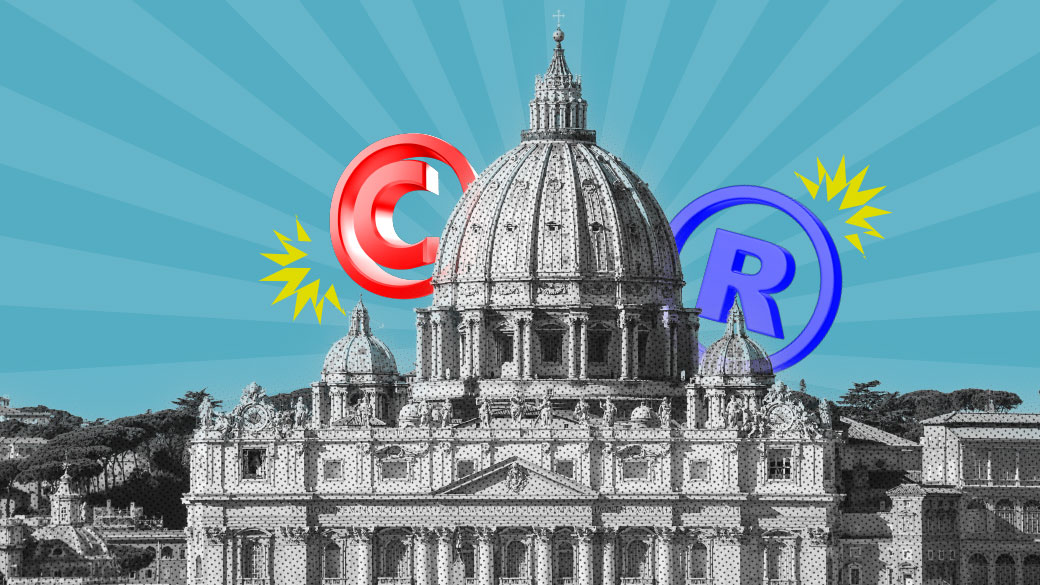
The Vatican City, officially the Vatican City State, or simply the Vatican, being a sovereign country and seat of the Catholic Church, adopts a very rigorous protection of its religious symbols and its identity, using IP instruments such as trademark and domain name registrations, to protect logos, emblems, names and official symbols (for example, papal coat of arms, logos of events such as the Jubilee, expressions such as "Habemus Papam").
Trademark protection serves to combat counterfeiting, to maintain control over the use of symbols and to safeguard the sacredness of religious signs, also to prevent them from being used improperly or commercially without authorization.
Trademarks registered by Vatican - or its bodies and institutions – include, among others:
- “Peregrinatio Ad Petri Sedem”, i.e. the partial representation of the coat of arms of the Vatican City State;
- “Vatican Media”, the official trademark for the distribution and protection of sounds, images and videos relating to the activity of the Pope and the Holy See, said trademark being managed by the Dicastery for Communication of the Holy See;
- “Basilica di San Pietro”, registered both as word mark and figurative mark by La Fabbrica di San Pietro in Vaticano (Saint Peter's Factory: The Vatican School of Arts and Crafts);
- “MV” o “EMV”, i.e., the trademarks of the Vatican Museums, registered by the Directorate of Museums and Cultural Heritage - Governorate of the Vatican City State;
- “Stato della Città del Vaticano”, registered in the United States of America.
Protection for trademarks, as well as for patents and designs in the Vatican City State must be applied for at the Italian Patent and Trademark Office (UIBM).
Indeed, registration of a trademark in Italy not only confers protection within the Italian territory and in the Republic of San Marino, but it is also recognized in the Vatican City, thanks to the bilateral agreements in force between these States.
In other words, a trademark registered in Italy is automatically protected also within the Vatican territory, without the need for a specific separate registration procedure in the Vatican City State.
However, the same does not apply to European Union trademarks, which protect all EU Member States, but does not automatically include the Vatican. Therefore, to obtain protection in the Vatican, it is necessary to proceed with a national filing in Italy.
The Vatican City State has also taken steps to protect its domain names.
The national first-level domain name allocated to the Vatican City is .va, a Country Code Top Level Domain (ccTLD), as the Vatican is a sovereign state.
Yet, unlike other ccTLDs, which can be registered by anyone, the registration of domain names with the .va extension is reserved exclusively for official Vatican bodies, such as institutions, departments and offices of the Holy See; in fact, it is not possible for private individuals or external companies to register domains with this extension.
Official Vatican websites also use second-level domain names within the .va domain, such as vatican.va.
The domain .catholic, instead, can only be registered by Catholic religious organisations and schools, providing a unique identifier for websites related to the Catholic faith.
The Vatican City also uses the instrument of copyright to protect its symbols, names or logos.
Copyright protection in the Vatican City is now regulated by Vatican Law of 19 March 2011, No. CXXXII “on the protection of copyright and related rights”, which has entirely replaced the previous legislation which provided for the Italian legislation on copyright to apply also to the Vatican (Law No. 633 of 22 April 1941).
The Vatican Copyright Law consists of only eight articles. According to Article 1, the Italian Copyright Law applies on a supplementary basis to any matter relating to the protection of copyright involving the Vatican City and which is not specifically regulated by the Vatican Copyright Law. It is, in fact, provided that Italian law is applicable as long as it is not in conflict with divine law, with the general principles of canon law, with the provisions deriving from international treaties signed by the Holy See or with the provisions of the Lateran Pacts and subsequent agreements between Italy and the Vatican City and is applicable in relation to the specific case.
Furthermore, it is worth noting that the Holy See is a member of the Berne Convention for the Protection of Literary and Artistic Works, under which “authors shall enjoy, in respect of works for which they are protected under this Convention, in countries of the Union other than the country of origin, the rights which their respective laws do now or may hereafter grant to their nationals, as well as the rights specially granted by this Convention”.
This means that the rights conferred by the Vatican Copyright Law and/or by the Italian Copyright Law on a work are applicable in all countries adhering to the Berne Convention (including France, Germany, Italy, the United Kingdom and the United States of America).
But can religious symbols or names be protected only by the Vatican City?
Theoretically, the answer is no. In fact, third parties are allowed to register religious symbols as trademarks (think for example of local religious communities). However, there are some important limitations to consider.
First of all, Article 10 of the Italian Industrial Property Code prohibits the registration of well-known symbols that are of public interest, such as many religious symbols, unless the competent authority authorises such registration.
The law aims to prevent religious symbols of great public and cultural relevance from being monopolized or commercially exploited by private individuals without authorization, thus protecting the collective interest and religious sensitivity.
Furthermore, registration may be denied if the trademark is contrary to the law, public order or morality or if it is devoid of distinctive character.
Italian case law, for example, has often denied the registration of trademarks that use universally recognized religious names or symbols (such as "Jesus", "Mother Mary, "Buddha"), considering that they do not have sufficient distinctive character or that they may be offensive to religious sentiment, and therefore contrary to public order.
In fact, the Italian Court of Cassation ruled that the trademark “BUDDHA” was invalid due to a lack of distinctive capacity because “it not only evokes a religion, but also communicates adherence to or in any case interest in a philosophy and a lifestyle that are connotative of a custom that is now pertinent to the most diverse manifestations of social action, from literature to music, from the figurative arts to cooking, so much so that it has become fashionable”.
In the light of the above, if your Clients want to protect a religious symbol or a name that can recall the religious world - whatever it is -, it is advisable to ask for an opinion from an expert in intellectual property, to avoid the risk of receiving disputes. In this regard you may wish to contact our professionals at email@interpatent.com.