





The aim of these articles is to keep our Clients and Associates updated about developments in the sector of Intellectual Property in general and our firm in particular. In this way, we wish to provide a broader view of the tools that the field of trade marks, domain names, patents, designs and related rights offers to entrepreneurs to enhance and protect their efforts in researching and developing new solutions and ideas.
The Interpatent Team is Growing Again!
We are pleased to announce that our team is expanding further. Joining us are Gian Antonio Pancot and Marilena Garis.
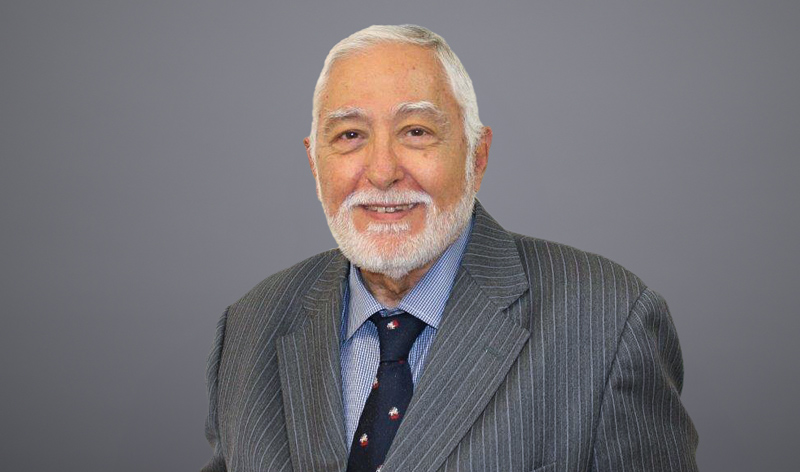
Gian Antonio brings with him over forty years of solid experience in the field of Intellectual Property, where he began working in July 1978. From 1980 to 1993, he served as CEO of one of the leading Italian firms in the sector, of which he was also a partner. He was later called to join another top-tier consulting firm in Rome, where he remained until the end of 2006. At that point, he joined a world-leading group in the field of Research & Development (R&D) as CEO, focusing on Intellectual Property management and support, with a particular emphasis on the economic valorization of patent rights. From 2017 to 2020, he also held the roles of President and CEO of another Italian professional firm operating in the Intellectual Property sector. Since then, he has continued to work in the same field, collaborating with other professional firms.
Gian Antonio has recently joined the Interpatent team with the goal of contributing not only his specialized expertise in Intellectual Property, but also his extensive experience gained through working closely with major international patent and trademark holders, thereby providing a significant contribution to the enhancement of their activities and services.
Registered with the Italian Industrial Property Consultants Institute (in both the Patents and Trademarks/Designs sections), he is also a qualified representative before the European Union Intellectual Property Office (EUIPO). Since 2020, he has served as Vice President of LES Italy and is also a member of several other Intellectual Property associations, including AIPPI, FICPI, AICIPI, LIGUE, among others. He has contributed to publications, lectures and conferences on industrial and Intellectual Property matters.
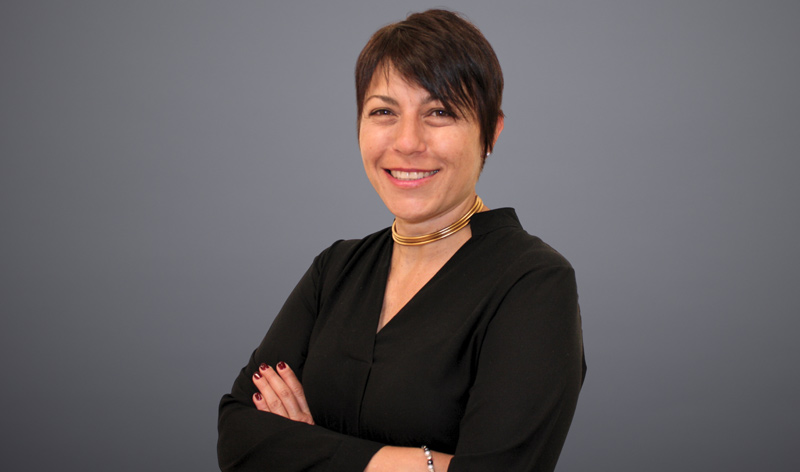
Marilena will enhance our team with her extensive experience in Intellectual Property, a field she has been working in since 2001 within leading national firms.
Marilena holds a law degree with a specialization in transnational law from the University of Turin (2001) and obtained a Master’s in Corporate Law (2018). She has collaborated with the University of Turin as a subject expert, contributing to the courses in Industrial Law (Economics and Business degree program) and Intellectual Property Law (Communication Sciences degree program). She is registered with the Italian Industrial Property Consultants Institute (in the Trademarks/Designs section) and is also admitted to practice before the EUIPO.
Marilena represents both Italian and international clients, providing them with strategic advice on Intellectual Property matters, coordinating the protection of trademark portfolios worldwide, handling oppositions and cancellation actions and negotiating contracts. She has established strong professional relationships with legal and Intellectual Property experts on an international level. Since 2020, she has been a member of the Executive Committee and an International Delegate of LES Italy, as well as a member of AIPPI (Italian group). She has contributed to numerous publications, lectures and conferences on industrial and Intellectual Property matters, including for Il Diritto Industriale, SPRINT, Italia Oggi, Managing Intellectual Property, World Trademark Review, LES International and Il Sole 24 Ore."
To introduce them to you in the best possible way, we asked them a few questions.
Gian Antonio Pancot
Q: What are the most common mistakes companies make in managing Intellectual Property?
A: I believe that, although considerable efforts have been made at all levels in recent years, only now are the most astute companies beginning to fully recognize the significance and importance of Intellectual Property (IP). I don’t think the focus should be on mistakes (or alleged mistakes), but rather on the limited awareness of what patents, trademarks, designs, domain names, as well as trade secrets, copyright and other intangible assets (which fall under 'intellectual capital' and constitute a substantial part of so-called 'intangible assets') represent in terms of value for a company – whether large, medium-small, or artisanal – either manufacturing or service-based.
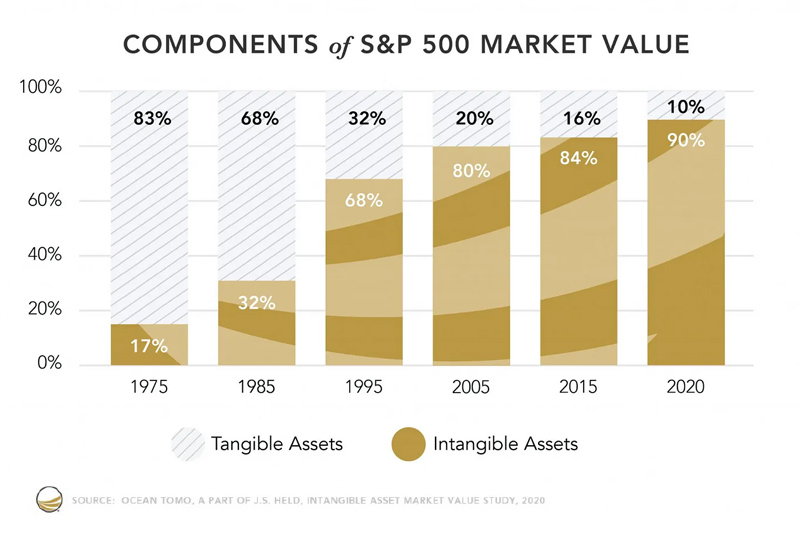
Many considerations can be made on this subject, but briefly, it is enough to note that the American company Ocean Tomo (part of JS Held, providing expert opinions and consulting focused on Intellectual Property and other intangible assets) found that whereas in the 1970s intangible assets represented about 20% of a company's value, today this proportion is reversed: trademarks, patent portfolios, designs, as well as management reputation, employees’ know-how and the customer base account on average for 80% of a company’s market value, as illustrated in the chart below.
Furthermore, in some cases, especially during a period of significant transformation as experienced in recent years, the strategic lack of an adequate portfolio of patents and trademarks has hindered the successful transfer of production and sales to outsourcing (i.e., to lower-cost areas) in order to prioritize internal creativity, research and development, as did instead those companies that have grown and developed by giving proper attention and substantial importance to Intellectual Property and licensing activities.
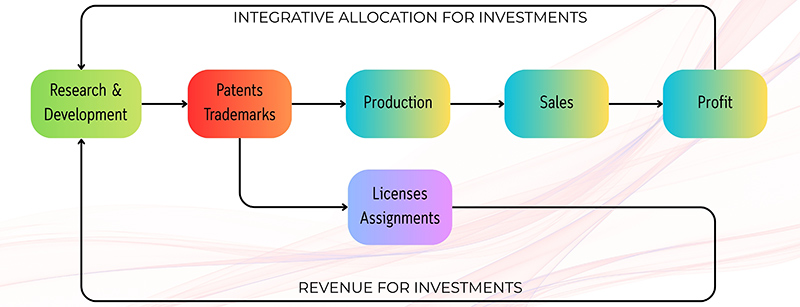
More generally, the opportunity to implement an 'integrative cycle' like the one illustrated below was missing:
Integrative Cycle Providing Additional Benefits
There are many other reflections that could be made on this topic, which are omitted here for brevity. However, a brief mention must be made of the mistaken belief that patents and trademarks represent a 'cost for the company' rather than an investment. This leads to a lack of awareness about the possible 'valorization' of these assets, which are fully part of a company’s heritage. More generally, among a large number of stakeholders, there is still a lack of full understanding and culture regarding the potential and importance (broadly understood) of Intellectual Property.
Q: What advice would you give to a startup or an inventor approaching Intellectual Property protection for the first time?
A: The advice I usually give in such circumstances is based on the following twofold approach: on one hand, acquire a thorough understanding of the sector in which you intend to operate; on the other hand, abandon the 'do-it-yourself' mindset and rely on consultants with proven experience – whether accountants, marketing experts, or Intellectual Property consultants – with whom companies can engage to form a working team or partnership to review the business plan, budgets (including those aimed at defining financial needs within implementation timelines), invention protection and so on.
The success of any initiative cannot disregard the analysis and the drafting – as clear and complete as possible – of all its components, along with the simultaneous definition of timelines, responsibilities and financial coverage necessary to ensure the market entry and distribution of the related products or services, where the commercial and marketing aspects will play a key role in supporting corporate success.
Q: Why is it essential to rely on an expert for the management and protection of IP rights?
A: The field has evolved and expanded so extensively over the years that specific, highly qualified professional figures have emerged in the consulting market. I emphasize that, in addition to the evolution of national legislation, supranational agreements, conventions, directives and regulations have been introduced, which cannot be overlooked. From this follows the inevitable conclusion that it is necessary to rely on experts – IP consultants – to obtain the best possible comprehensive assistance and protection, thereby reducing the risk of failure of any initiative involving the adoption of IP rights, safeguarding the efforts and sacrifices of inventors and investors.
Q: How does your experience allow you to offer personalized solutions to clients?
A: In the professional organization I decided to join, I was able to preliminarily verify the concrete existence of ongoing solid training, the availability and full openness to all accessible sources of information and updates on the subject, as well as a widespread network of reliable and continuously monitored foreign agents worldwide. These are all essential elements to seriously and diligently ensure the best and most qualified consultancy in the various areas related to IP. Added to this are the experiences that some professionals have developed within other settings, from which they have gained knowledge that allows for better interaction with clients. Finally, professional development is enhanced by active involvement in the subject matter, with almost all professionals serving as active members of study committees at various levels, speakers at events and authors of articles published in industry journals. Sharing the vision that places full and qualified attention to client needs and satisfaction as a priority, I have aimed to contribute my own – partially diversified yet complementary – expertise developed over more than 40 years of proven experience and work.
Marilena Garis
Q: What have been the key moments in your educational and professional journey?
A: After earning my law degree with a transnational focus, I began practicing law.
Given my inclination toward international fields and my language skills (English, French, German), I joined a leading Intellectual Property firm, where I quickly progressed through the initial stages and was soon integrated as an associate.
At the same time, I cultivated an academic commitment by collaborating with some prestigious legal journals in the field, particularly on trademark matters.
More recently, my active participation in a prestigious international industry association (where I served as a member of the Executive Committee and as an International Delegate) has allowed me to gain significant experience and contribute importantly through publishing texts on trademarks and participating in events as a speaker and/or moderator of roundtables.
Q: Was there an event or a person who particularly influenced your career?
A: There have been numerous occasions where I was an integral part of professional work teams that allowed me to expand my experience abroad (in Europe, the United States, Russia and China) by handling important cases for major clients.
I am grateful to many senior professionals for their contributions to my training: among my various experiences, I personally hold unforgettable memories of those who trusted me and, at the same time, helped pass on the knowledge from their authoritative expertise.
Q: What strategies do you recommend for the protection and enhancement of your clients’ Intellectual Property rights at the national and international levels, and why is it important to leverage your IP assets?
A: The message I aim to convey to clients is based on a relationship of trust built through the professional services I provide in response to their needs. I have always tried, with complete transparency, to emphasize the importance of IP as an investment, working with clients to implement protection plans spread over time, based on precise programs that consider the benefits and protective aspects of their trademarks. In this regard, I have also been involved in developing anti-counterfeiting projects in the geographic areas of greatest economic interest to clients.
Q: How is the Intellectual Property sector changing with the advent of new technologies (e.g., artificial intelligence, blockchain, etc.)?
A: On a purely practical level, new technologies have not yet significantly affected our professional work itself, but they have had a considerable effect on the procedural and strategic aspects, which now demand increasing levels of up-to-date knowledge and flexibility in the execution of IP tasks.
We believe that the addition of Gian Antonio and Marilena to the Interpatent team will be key to successfully tackling upcoming challenges in IP and that their support will help us reach new goals.
A warm welcome to them both!