





The aim of these articles is to keep our Clients and Associates updated about developments in the sector of Intellectual Property in general and our firm in particular. In this way, we wish to provide a broader view of the tools that the field of trade marks, domain names, patents, designs and related rights offers to entrepreneurs to enhance and protect their efforts in researching and developing new solutions and ideas.
Intellectual Property: The Key to Success for European Companies
We often hear about how owning intellectual property (IP) rights is critical for companies wishing to remain competitive and thrive in today's marketplace. Patents, trademarks, and designs not only protect a company's innovations and creations but also offer a significant economic advantage. Indeed, with IP rights, companies can safeguard their investments in research and innovation, laying the groundwork for further technological and creative advances. In addition, intellectual property rights can facilitate access to international markets, enhance corporate reputation, and attract investment.
The European Patent Office (EPO) and the European Union Intellectual Property Office (EUIPO) have recently conducted a study that analyzes the relationship between IP rights and business performance in the European Union, going to corroborate with tangible data how beneficial and profitable it actually is for a company to invest in intellectual property.
Indeed, the main finding of the study is that companies that own at least one type of IP rights generate higher revenues per employee and offer higher wages than those that do not.
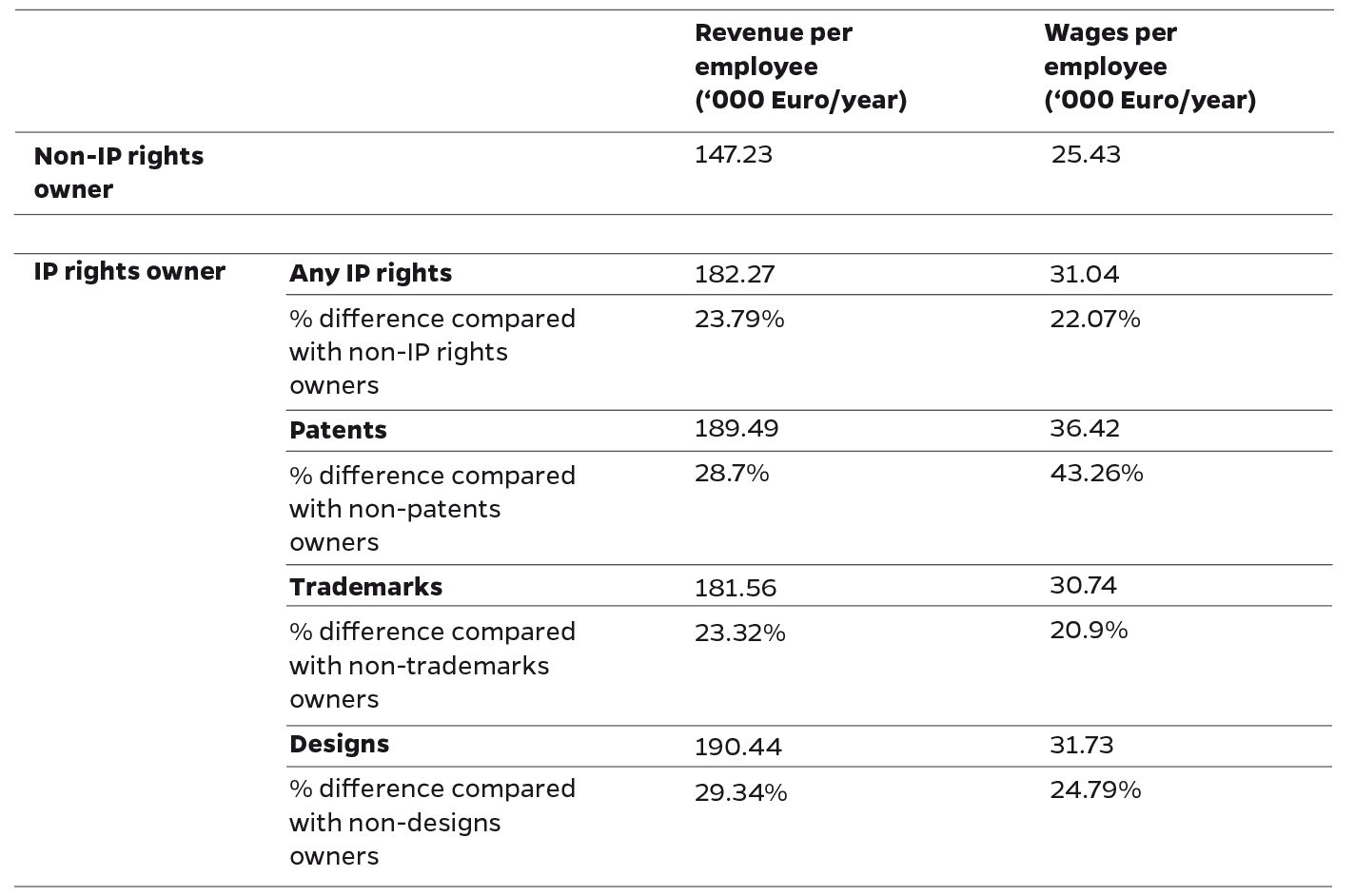
In fact, the data summarized in the table below show that companies that own at least one type of IP rights (patents, trademarks and designs) have on average 23.79% higher revenue per employee than companies that do not. If we then look specifically at companies that own patents and those that own designs, the difference in revenue per employee compared to companies that do not own them rises to 28.7% and 29.34%, respectively.
Also, as far as wages are concerned, companies that own IP rights pay on average 22% higher wages than companies that do not own them. This difference increases considerably when looking specifically at companies that own patents, which pay salaries that are as much as 43.3 percent higher than companies that do not own patents.
(source: EPO)
Further econometric analysis of the collected data that takes into account multiple relevant factors (such as country, sector, company age, company size, IP rights status, etc.) shows that the revenue per employee of companies that own active IP rights is 41% higher than companies that do not own IP rights. If we then discriminate by company size, the difference in revenue between those who own active IP rights and those who do not own IP rights is even larger for small and medium-sized enterprises (SMEs), reaching as high as 44%, compared with a difference of 16% for large enterprises. The data therefore suggest that SMEs that own IP rights perform much better than their counterparts that do not.
An additional notable finding from the study is the disparity between SMEs and large enterprises in terms of ownership, with a significantly higher percentage of companies owning IP rights among large enterprises than among SMEs.
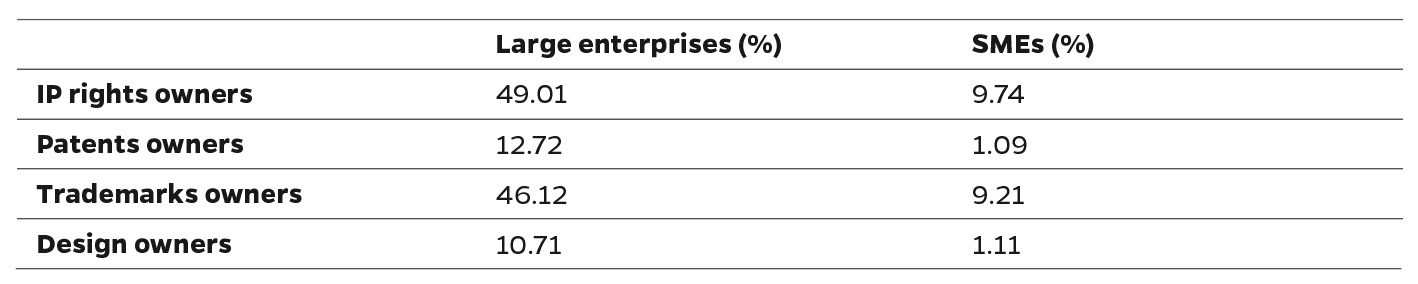
Indeed, the data, summarized in the table below, show that less than 10% of SMEs own at least one patent, trademark or design, while nearly 50% of large enterprises own at least one. This disparity becomes even more pronounced when considering patent ownership alone, with only 1.09% of SMEs owning at least one patent versus 12.72% of large enterprises.
(source: EPO)
While the above data clearly show that in general investing in IP is a winning strategy for companies of all sizes, these implications are even more evident for small and medium-sized companies: although relatively few SMEs invest in IP rights (compared to large enterprises), those that do so perform significantly better than their counterparts that do not own IP rights.
Finally, with regard to the technology sector in which companies owning IP rights operate, the study found that the sector owning the largest percentage is information and communication (14.79%), followed by manufacturing (14.21%), water supply, sewerage, waste management and remediation activities (11.98%), professional, scientific and technical activities (10.68%), and wholesale and retail trade, repair of motor vehicles and motorcycles (10.63%).
Although the data contained in the EPO study reported above do not demonstrate an immediate causal relationship, they strongly suggest that there is a systematic and positive relationship between IP rights ownership and companies’ economic performance, which should encourage EU companies of all sizes to strengthen the protection of their innovations through intellectual property.